Contact us
Send Us Your Case Details
We’ll respond and let you know the best way to proceed with your case.



Yes, a hit-and-run victim in Dayton can generally file a car accident claim, even if the at-fault driver is never identified. Ohio law provides several pathways for injured victims to pursue compensation, including uninsured motorist (UM) coverage and civil lawsuits if the driver is eventually found. However, hit-and-run claims come with unique evidentiary requirements and legal hurdles. Understanding your rights under Ohio law is the critical first step toward recovering compensation for medical bills, lost wages, and other damages.
If you were hurt in a Dayton hit-and-run, you do not have to navigate this process alone. The Attkisson Law Firm is ready to help you understand your options. Call 937-400-0000 or reach out online to discuss your case today.
Under Ohio Revised Code Section 4549.02, any driver involved in an accident must immediately stop, remain at the scene, and provide their name, address, and vehicle registration to injured persons, other operators, and police. When a driver flees, they violate this fundamental obligation.
If the injured person cannot comprehend the required information, the at-fault driver must notify the nearest police authority and remain at the scene until an officer arrives. This safeguard exists because accident victims may be incapacitated or in shock.
Since January 2021, there have been nearly 23,000 hit-and-run crashes across several southwest Ohio counties, including Montgomery County. Motorists often flee because they are unlicensed, intoxicated, uninsured, have outstanding warrants, are driving a stolen vehicle, or are fleeing another crime.
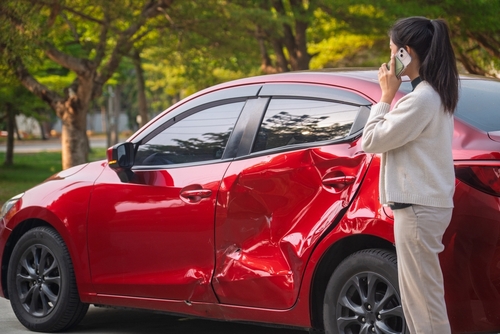
Failing to stop after an accident carries severe criminal consequences that escalate based on the severity of harm caused. Ohio law treats hit-and-run offenses with increasing seriousness depending on whether injuries, serious physical harm, or death results.
| Circumstance | Charge Level |
|—|—|
| Default (leaving the scene) | First-degree misdemeanor |
| Serious physical harm results | Fifth-degree felony (fourth-degree felony if offender knew of the serious harm) |
| Death results | Third-degree felony (second-degree felony if offender knew the collision caused death) |
Violators also face a mandatory class five license suspension, with the first six months non-reducible by a judge. Criminal prosecution alone does not compensate you for injuries. A separate civil or insurance claim is necessary to recover damages.
💡 Pro Tip: Document everything at the scene, even if the other driver has fled. Photos of vehicle damage, skid marks, traffic signals, and your injuries can serve as valuable evidence if you later file a UM claim or civil lawsuit.
A hit-and-run case presents challenges that differ significantly from a standard car accident claim. When the at-fault driver cannot be identified, victims must often turn to their own insurance policies for compensation. An experienced car accident lawyer in Dayton can help you identify every available coverage, gather corroborating evidence, and negotiate with insurers who may attempt to minimize your claim.
Hit-and-run victims must meet Ohio’s independent corroborative evidence requirement before their UM insurer will pay. An attorney familiar with these cases understands what evidence satisfies this threshold and can build your claim from the start.
💡 Pro Tip: Report the hit-and-run to police immediately and request a copy of the crash report. This official record can serve as key corroborative evidence when you file your insurance claim.
Ohio law does not require auto insurance policies to include uninsured motorist coverage; it is entirely optional. Under Ohio Revised Code Section 3937.18, a policy "may, but is not required to, include uninsured motorist coverage." However, UM coverage is one of the most important protections a Dayton driver can carry, because a hit-and-run driver whose identity cannot be determined qualifies as an "uninsured motorist" under Ohio law.
Ohio’s UM/UIM coverage pays when you are injured by a driver who has no insurance or cannot be identified. If you elected UM coverage, you may recover compensation for medical expenses, lost income, and pain and suffering through your own insurer.
Under Ohio Revised Code Section 3937.181, any policy that includes UM coverage must also make available coverage for property damage caused by uninsured motorists. This property damage coverage is capped at $7,500 or the policy limit, whichever is less, with a maximum $250 deductible. However, this coverage requires the uninsured motorist to be identified. If the hit-and-run driver remains unidentified, your collision coverage may be your primary option for vehicle repair costs.
💡 Pro Tip: Review your auto insurance policy now, before an accident happens. If you do not currently carry UM/UIM coverage, consider adding it. It is often affordable and may prove invaluable after a hit-and-run.
One of the most significant legal hurdles for hit-and-run victims in Ohio is the corroborative evidence rule. Under Section 3937.18(B)(3), the testimony of the insured seeking recovery is not sufficient on its own unless supported by additional evidence. The statute requires "independent corroborative evidence" to prove that bodily injury was proximately caused by the negligence of the unidentified driver.
The insured must also prove all elements of their claim as if they were recovering directly from the at-fault driver. This includes establishing duty, breach, causation, and damages. Evidence that may satisfy this standard includes:
Working with an attorney who has handled Dayton hit-and-run claims can make a meaningful difference in whether your claim succeeds or is denied.
💡 Pro Tip: If any nearby businesses or homes may have security cameras that captured the crash, ask for the footage quickly. Surveillance video is often overwritten within days or weeks, so time is critical.
Ohio’s Financial Responsibility Law sets minimum liability coverage at $25,000 per person and $50,000 per accident for bodily injury, plus $25,000 for property damage. It is illegal to drive any motor vehicle in Ohio without insurance or other proof of financial responsibility.
Ohio insurance policies may impose a three-year deadline from the date of the accident for filing a UM/UIM claim. However, the general statute of limitations for personal injury in Ohio is two years. Courts interpret tolling exceptions narrowly, so victims should act promptly to preserve both evidence and legal rights.
MedPay is another optional coverage worth noting. It pays medical expenses for you and your passengers following an accident, regardless of fault. For hit-and-run victims, MedPay can help cover immediate treatment costs while your UM claim is being processed.
💡 Pro Tip: Keep a detailed file of all medical records, bills, repair estimates, and correspondence with your insurer from the very beginning. Organized documentation strengthens your claim and can help prevent unnecessary delays.
Taking the right steps after a hit-and-run can significantly affect your ability to recover compensation. Here is what you should prioritize:
Dayton police advise that victims can help by gathering license plate numbers and descriptions of vehicles and drivers. Even partial details can help law enforcement track down the responsible party. Incidents like the Refugee Road hit-and-run in Dayton illustrate how dangerous these crashes can be and why swift action matters.
Yes. If you carry uninsured motorist coverage, you may file a UM claim against your own insurer. Ohio law treats an unidentified hit-and-run driver as an "uninsured motorist." However, you will need to provide independent corroborative evidence beyond your own testimony.
Your options may be more limited but not eliminated. You may be able to use MedPay coverage for medical expenses, file a claim through your health insurance, or pursue a civil lawsuit if the at-fault driver is eventually identified. Consulting an attorney can help you evaluate all available avenues.
Ohio’s general personal injury statute of limitations is two years from the date of the accident. Additionally, your insurance policy may impose a three-year deadline for filing a UM/UIM claim. Begin the claims process as soon as possible after the crash.
Ohio requires independent corroborative evidence to support your account. This can include police reports, witness testimony, surveillance video, dashcam footage, physical evidence at the scene, and medical records documenting your injuries. Your testimony alone is insufficient unless supported by additional evidence.
No. Under Ohio Revised Code Section 3937.18, UM coverage is optional. However, because hit-and-run drivers are treated as uninsured motorists, carrying UM coverage provides crucial financial protection if you are ever the victim of a hit-and-run.
A hit-and-run crash can leave you with serious injuries, mounting medical bills, and frustration when the responsible driver disappears. Ohio law provides meaningful pathways for victims to pursue compensation through UM coverage, MedPay, and civil claims, but each option comes with specific legal requirements. The corroborative evidence rule, policy deadlines, and the burden of proving negligence all make these cases more complex than they may first appear.
If you or a loved one was injured in a hit-and-run in Dayton or anywhere in Montgomery County, The Attkisson Law Firm is here to help you fight for fair compensation. Call 937-400-0000 or contact us today for a free consultation about your car accident claim.