
The Paper Trail Behind Every Commercial Truck Driver
Key Takeaways: A driver qualification file is the federally required personnel record, governed by 49 CFR Part 391, that a motor carrier must keep for every commercial driver it allows on the road. It generally contains the driver’s employment application, road test certificate, license verification, evidence of medical qualification, motor vehicle record checks, annual driving record reviews, and prior-employer safety performance inquiries. In a Dayton truck crash case, this file may show whether the trucking company should have put that driver behind the wheel at all, potentially supporting negligent hiring and supervision claims against the carrier itself. Gaps such as a missing prior-employer inquiry or a lapsed medical certification are often more revealing than the documents present, though Ohio law still requires proof of duty, breach, causation, and damages. Because retention periods for related records are short and Ohio generally allows two years for injury and wrongful death claims, early preservation letters and prompt discovery are important.
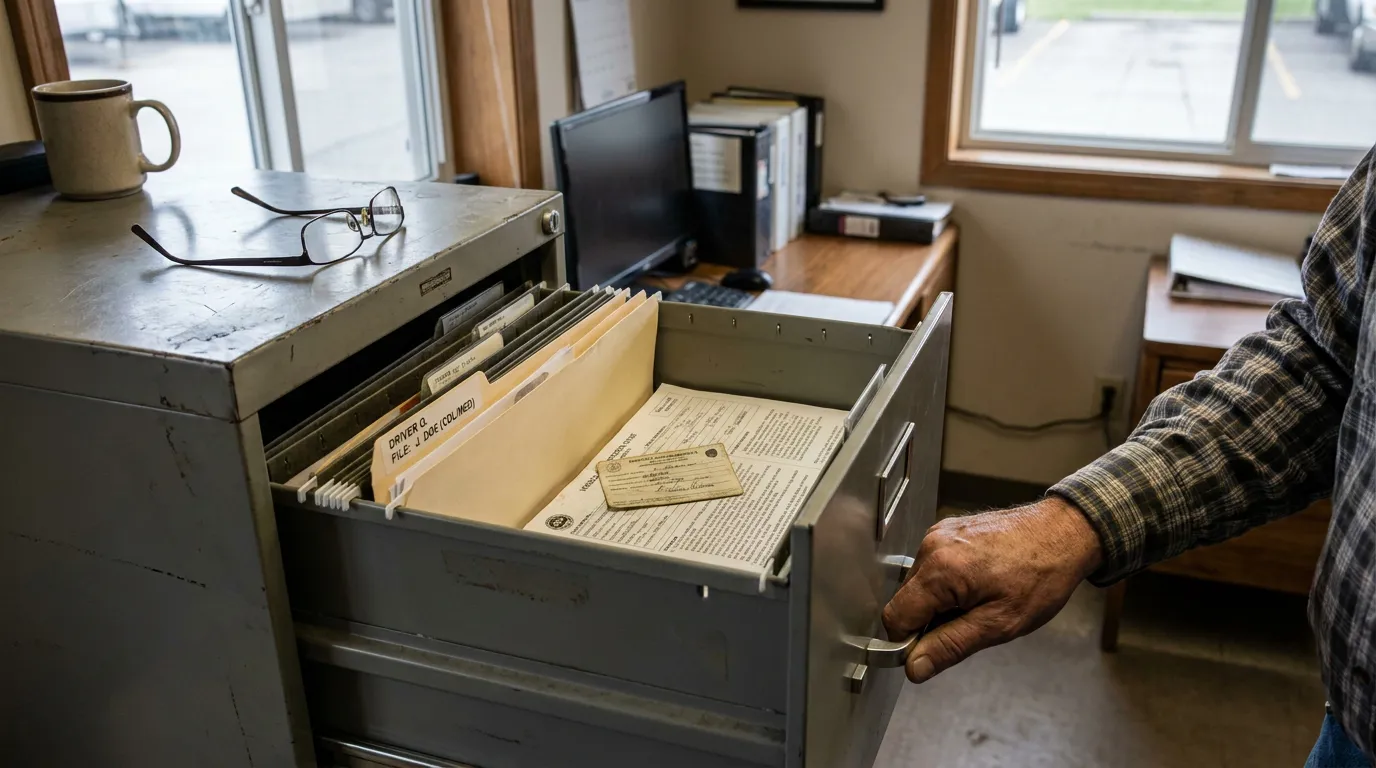
A driver qualification file, or DQ file, is the federally mandated personnel record a motor carrier must keep for every commercial driver it puts on the road. Under FMCSA’s rules at 49 CFR Part 391, the file shows the company checked the driver’s background, licensing, medical fitness, and safety history before handing over the keys to a vehicle that may weigh up to 80,000 pounds. After a serious collision in Dayton, this file frequently becomes one of the most revealing pieces of evidence in the case.
If you or a family member suffered life-altering injuries in a collision with a commercial truck, the window to preserve these records can be short. The Attkisson Law Firm helps injured people and grieving families in Dayton pursue accountability from motor carriers and their insurers. Call 937-400-0000 or contact us now to discuss what happened.
Why the DQ File Matters So Much
The DQ file may address a question police reports rarely cover: should this driver have been behind the wheel at all? A crash report documents what happened seconds before impact. The qualification file documents decisions made weeks, months, or years earlier, a distinction that can support a direct claim against the carrier in addition to a claim based on the driver’s conduct.
Federal regulations generally apply uniformly to carriers in interstate commerce, so a company hauling freight through Montgomery County is typically bound by the same standards as one in Texas or California. FMCSA’s authority flows from 49 U.S.C. Chapter 311, and its rulemaking record is published through its Federal Register documents library. Because these are federal rather than Ohio-specific rules, the compliance analysis in a Dayton case looks similar to elsewhere, subject to how Ohio courts handle evidence and negligence doctrines.
What Federal Law Requires Inside a DQ File
Under 49 CFR 391.51, a motor carrier must generally maintain a qualification file for each driver, and the regulation lists specific documents that belong in it. Contents vary by driver status and tenure, but core items are generally consistent:
- The employment application under 49 CFR 391.21, requiring at least three years of employment history and, for CDL positions, ten years of DOT-regulated employment history
- A road test certificate or accepted equivalent
- Verification of CDL status, such as a motor vehicle record from each licensing state
- Documentation of physical qualification, historically the medical examiner’s certificate under 49 CFR 391.43
- Motor vehicle record checks at hire and annually thereafter
- The annual review of the driver’s driving record
- Safety performance history inquiries to prior DOT-regulated employers from the preceding three years under 49 CFR 391.23
Each item exists for a reason and can create a potential point of failure. A missing prior-employer inquiry may mean the carrier never learned of hours-of-service violations or a prior positive drug test. A lapsed medical certification may mean nobody confirmed the driver was still fit to operate. Gaps in a file may be more informative than the documents present, though a gap alone does not establish liability.
The Medical Certificate Component
Medical certification is often overlooked, and it is frequently where problems surface. Federal occupational health research has examined conditions common among long-haul drivers, including fatigue, sleep apnea, and cardiovascular risk. A NIOSH study of truck driver health explains why physical qualification screening became mandatory.
If a driver’s certification lapsed or was issued despite a disqualifying condition, that fact may support a claim that the carrier allowed an unqualified driver to operate. Courts may consider such evidence relevant to negligence and to the reasonableness of hiring and monitoring practices, though this depends on the medical facts and independently-proven causation.
Drug and Alcohol Testing Records
Testing records are closely related to the DQ file but are generally maintained separately under 49 CFR Part 382, subject to confidentiality restrictions. Pre-employment, random, reasonable-suspicion, and post-accident testing all generate documentation the carrier must retain for set periods. Incomplete records may raise fair questions about compliance, though access in litigation is often governed by protective orders.
Federal research supports this testing regime. NHTSA has sponsored case-control research on crash risk associated with alcohol and drug use by drivers, with the strongest associations found for alcohol, helping explain why testing documentation is treated as a serious compliance obligation.
How a DQ File Supports Negligent Hiring Claims
In many truck crash cases, the injured person may have two theories against the company: vicarious liability for the driver’s conduct, and direct liability for the company’s own hiring decisions. The qualification file is often central to the second theory. If it shows a carrier hired a driver with a documented pattern of unsafe conduct, or never checked at all, that may support a negligent hiring, retention, or supervision claim under Ohio law.
Ohio courts generally require a plaintiff to show an underlying tort by the employee, that the employer knew or should have known of the employee’s incompetence, and that this failure proximately caused the injury. These claims are fact-dependent. Carriers frequently argue that an admission of respondeat superior liability makes a separate direct-negligence claim duplicative; Ohio appellate decisions have not resolved that question uniformly, so viability can depend on the court, procedural posture, and whether punitive damages are sought.
| Document in the File | What It May Reveal |
|---|---|
| Employment application | Gaps in work history or undisclosed prior terminations |
| Prior employer inquiries | Whether past safety violations were ever investigated |
| Annual MVR review | A pattern of citations the carrier tolerated |
| Medical examiner’s certificate | Lapsed or questionable physical qualification |
| Road test certificate | Whether skills were ever actually verified |
💡 Pro Tip: Ask your attorney about sending a spoliation letter early. Federal retention periods for some records are measured in months, not years, and a written preservation demand may affect the legal consequences if documents later go missing.
Getting the File: Preservation and Discovery Realities
Trucking companies often do not hand over qualification files voluntarily, and retention obligations for related records expire on schedules that may favor the carrier. Qualification files generally must be kept for the period of employment plus three years, but supporting records like hours-of-service logs and inspection reports have much shorter retention periods, making prompt action especially important. A Dayton attorney can demand specific trucking records through formal discovery, but preservation letters should go out well before a lawsuit is filed.
Discovery disputes over commercial driver records are common. Carriers may claim documents are confidential, were never created, or fall outside relevant scope. Ohio courts have discretion in resolving these disputes, and outcomes often depend on how specifically requests are framed. Ohio recognizes an independent tort for intentional destruction or physical alteration of evidence (spoliation), but does not extend this tort to intentional interference with or concealment of evidence; for interference or concealment, the remedy is limited to discovery sanctions under Ohio Civil Rule 37.
Statute of Limitations Considerations
Ohio generally provides a two-year limitations period for bodily injury claims under Ohio Rev. Code § 2305.10, and wrongful death actions are generally subject to a two-year period from the date of death under § 2125.02. These deadlines are not the same as evidence retention deadlines, and waiting near the end of the limitations period can mean critical records no longer exist.
Exceptions such as tolling for minority or unsound mind, or discovery-based accrual, may apply in limited circumstances, but Ohio courts generally construe these narrowly. If a governmental entity is involved, separate notice or shorter requirements may apply independently of the general statute of limitations. Only an attorney reviewing specific facts can confirm which deadline governs.
Common Problems Injured Dayton Residents Encounter
One of the most frequent obstacles is simply timing. Families dealing with intensive care, rehabilitation, and funeral arrangements may not be thinking about federal recordkeeping rules in the first weeks, while the carrier’s rapid response team may already be gathering its own evidence.
A second obstacle is assuming a clean-looking file ends the inquiry. A file can be technically complete and still reveal problems when compared against hours-of-service logs, maintenance records, and dispatch data. Cross-referencing these sources is where a thorough investigation into truck crash liability tends to produce results.
💡 Pro Tip: Keep every piece of correspondence from the trucking company’s insurer, including voicemails. Early contact often precedes a low offer, and the timeline of those communications can matter later.
Frequently Asked Questions
1. How soon after a Dayton truck crash should the DQ file be requested?
As soon as possible. Some federal retention obligations for related records are relatively short, and an early preservation letter may mean the difference between receiving complete records and receiving partial ones.
2. Does a missing document automatically prove the trucking company is liable?
No. A regulatory violation may be admissible as evidence of negligence, and Ohio law sometimes treats violation of a safety statute as negligence per se, but the plaintiff must still prove causation and damages. Courts may treat noncompliance as one factor among several rather than a conclusive determination.
3. Do these federal rules apply to a local Ohio carrier?
It depends on whether the carrier operates in interstate commerce. FMCSA’s rules generally govern interstate carriers nationwide, while purely intrastate operations are subject to state-adopted rules, and Ohio has adopted much of the federal framework. An attorney can assess which framework applies.
4. What if the driver was an independent contractor?
The analysis becomes more complex, but it does not necessarily end there. Federal leasing regulations generally make the carrier whose operating authority is being used responsible for the vehicle’s operation, and qualification duties can extend to leased drivers. Lease agreements, operating authority, and degree of control all factor into the analysis.
5. Can the file help if the driver was never cited by police?
In some cases, yes. A citation decision reflects the officer’s judgment at the scene, not the carrier’s compliance history. Qualification and testing records may reveal issues no officer would have observed.
Where This Leaves You
The driver qualification file is a compliance record that federal law generally requires, and after a serious Dayton truck crash it can become a window into how a company actually operates. It may show careful screening, or it may show a carrier that cut corners and put an unqualified driver on Interstate 75. Either way, obtaining and analyzing it can be a foundational step. Because outcomes depend entirely on the specific facts, no one can predict a result from the file alone, but the evidence it contains may shape the direction of the case.
If a commercial truck collision has left you or someone you love with serious injuries, you do not have to sort through federal regulations on your own. The team at The Attkisson Law Firm can begin preserving evidence while you focus on recovery. Reach out by calling 937-400-0000 or schedule a consultation today.
Disclaimer: This content is for informational purposes only and is not legal advice. Every case is unique, and results may vary. Consult an attorney about your specific circumstances.